
If you’re arranging a dilapidation report, the first question is usually straightforward: how much will it cost?
The answer depends on what needs to be inspected. Documenting the condition of a single residential property is different from recording several buildings, boundary structures and extensive external areas before a major construction project.
When requesting a dilapidation report Melbourne quote, it helps to understand what the inspection involves rather than comparing prices without knowing what each provider includes.
Property size, accessibility, the number of structures, and reporting requirements can all influence the final amount. There is no single price that accurately represents every inspection.
Here’s how to work out what you’re paying for and which questions to ask before booking.
What Actually Determines the Cost of a Dilapidation Report?
The price generally reflects the time and work required to inspect the property and prepare its condition record.
Five factors are particularly relevant.
1. Property size and layout
Consider two properties: a compact townhouse and a large detached home with a garage, driveway and several external structures.
Even if both require a dilapidation report, the areas needing documentation may be very different.
A larger inspection area can mean additional observations, photographs and reporting work. However, property size alone doesn’t determine the price; the agreed inspection scope matters too.
2. Number of structures included
A report may need to document more than the main dwelling.
Depending on the proposed construction and the agreed scope, relevant areas could include boundary fences, retaining walls, garages, paving, paths and driveways.
Before accepting a quote, check whether these areas are included or whether additional structures will affect the cost.
3. Accessibility
Inspectors need suitable access to document the condition of relevant areas.
Locked spaces, stored materials, restricted boundaries or other obstructions can limit what can be inspected.
It is worth discussing access arrangements before the appointment, particularly when the inspection involves neighbouring properties.
4. Photographs and reporting requirements
A useful report needs more than a collection of property photographs.
The written observations should identify relevant existing conditions, while photographs help document what was visible during the inspection.
The extent of reporting can vary depending on the purpose of the inspection, the property and any applicable requirements.
5. Location and scheduling
The property’s location, travel requirements and appointment arrangements may influence a provider’s quote.
If construction is approaching, confirm how soon the inspection can be arranged and when the report is expected to be available.
Why Can Two Dilapidation Report Quotes Be So Different?
Imagine receiving two quotes for the same property.
One includes the dwelling’s accessible exterior. The other also covers selected internal rooms, a garage, driveway and boundary structures.
Although both services may be described as dilapidation inspections, they are not necessarily documenting the same areas.
That difference matters more than the price alone.
Before choosing a provider, ask:
- Which parts of the property will be inspected?
- Are internal and external areas included?
- Will garages, fences and other relevant structures be recorded?
- What photographic and written documentation will be supplied?
- Are there exclusions or additional charges?
- When will the completed report be provided?
You don’t necessarily need the broadest possible inspection. You need a scope that is appropriate for the property and the reason the condition record is required.
What Should You Receive for the Price?
A dilapidation report should help establish the property’s observable condition on the inspection date.
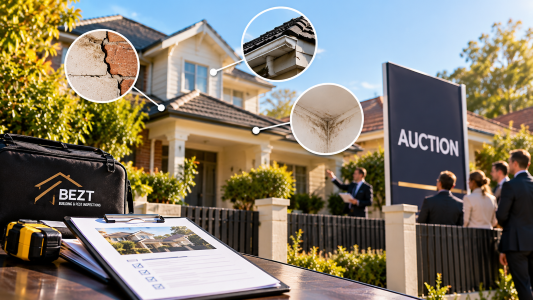
For example, an inspector may document existing wall cracks, deteriorated finishes, damaged paving or visible defects around relevant structures.
The report should connect those observations with appropriate photographic evidence and clearly identify the areas covered.
It should also communicate any relevant limitations. If a particular area couldn’t be accessed, the report shouldn’t give the impression that it was inspected.
When comparing dilapidation report Melbourne providers, ask to understand the proposed documentation rather than assuming all reports follow an identical format.
A report’s usefulness comes from the clarity and relevance of its observations, not simply the number of pages it contains.
Why Arrange the Inspection Before Construction Begins?
Suppose excavation is planned beside an existing home.
Before work begins, the property has several visible cracks and some deterioration around an external paved area. Those conditions are documented in a pre-construction report.
If concerns arise during or after construction, the earlier record can be reviewed to establish what was observed before the work started.
This doesn’t mean the report proves whether construction caused a later change. Establishing causation may require further professional assessment.
Its immediate purpose is to provide a reliable record of the condition visible at the time.
For a fuller explanation of timing and the role of condition documentation, read BEZT’s dilapidation report guide.
Does the Cheapest Quote Offer the Best Value?
Not necessarily, but an affordable quote isn’t automatically inadequate either.
A lower price may reflect a smaller inspection scope, a simpler property or different reporting requirements.
Equally, a higher quote may involve more areas, additional structures or more extensive documentation.
The sensible approach is to compare the service against what you actually require.
If the report is being arranged for a particular construction project, clarify whether there are specified inspection or documentation requirements before booking.
Choosing based on price alone can be misleading when the quoted scopes are different.
Who Pays for a Dilapidation Report in Victoria?
Payment arrangements depend on why the report is being organised.
For example, a homeowner may independently arrange an inspection because construction is planned nearby. A builder or developer may arrange condition documentation as part of preparing for proposed works.
There is also an important legal distinction in Victoria.
Under the Building Act 1993, where the relevant building surveyor determines that protection work is required for an adjoining property, the building owner must arrange a survey of that property with the adjoining owner before protection work begins.
The statutory process also includes obligations concerning notices, insurance and certain expenses. The applicable requirements should be confirmed for the particular project.
An ordinary commercial dilapidation report should not automatically be assumed to satisfy every requirement of a statutory adjoining-property survey.
If your report relates to formal protection work, establish the necessary scope and responsibilities before commissioning it.
Does the Property’s Melbourne Location Affect the Quote?
A property’s suburb may influence travel or scheduling arrangements, but location is only one consideration.
A straightforward property in Pakenham may involve a different inspection scope from a larger site in Werribee or a property with multiple structures in Craigieburn.
The same principle applies across Melbourne, including Berwick, Tarneit, Dandenong and surrounding areas.
BEZT provides inspection services across Melbourne and other listed locations. You can check the service areas page to confirm coverage.
When requesting a quote, share the property location, type of building, relevant structures and any known project requirements. This helps clarify the proposed inspection scope.
Understand the Scope Before You Book
A price is more useful when you know what it covers.
BEZT Building & Pest Inspections provides dilapidation report Melbourne services for property owners and projects requiring documentation of observable property conditions.
The inspection focuses on relevant accessible areas within the agreed scope, supported by written observations and photographic records.
If you’re comparing providers, the starting point should be the property itself: what needs to be recorded, why the inspection is being arranged and when the documentation is required.
Need a dilapidation report before nearby construction, demolition or excavation? Get an instant quote from BEZT Building & Pest Inspections based on your property and inspection requirements.
Look at What the Quote Actually Covers
The cost of a dilapidation report varies depending on the property and the level of inspection required.
Rather than comparing figures alone, consider the inspection areas, reporting detail, accessibility and purpose of the report.
A dilapidation report Melbourne property owners arrange should provide a clear record of observable conditions within its agreed scope. Understanding that scope is the best starting point for deciding whether a quote meets your needs.
Frequently Asked Questions
How much does a dilapidation report cost in Melbourne?
Pricing varies with the property’s size, the inspection scope, accessibility, structures requiring documentation and reporting requirements. For an accurate figure, request a property-specific quote rather than relying on an unverified general price.
Can I get a quote without arranging an inspection first?
You can request a quote before booking. Be ready to provide the property address, building type, relevant inspection areas and details of any nearby works. The provider may need further information to confirm the scope.
Will including a garage or boundary fence increase the price?
It may, particularly if those structures require additional inspection and documentation. Ask whether they are already covered in the proposed quote.
Is a dilapidation report required for every construction project in Victoria?
No. However, when the statutory protection-work process applies, an adjoining-property survey is required under the Building Act 1993. Other condition reports may be arranged voluntarily or for particular project requirements.
Can a report be completed after excavation has started?
An inspection can record conditions visible on the inspection date, but it cannot necessarily establish what existed before excavation commenced. Where a pre-work baseline is needed, earlier documentation is preferable.
Will I need to pay for another report after construction?
A follow-up inspection may be appropriate if the property’s condition needs to be compared with the original record. Whether another inspection is required and who pays depends on the circumstances and any applicable arrangements.