
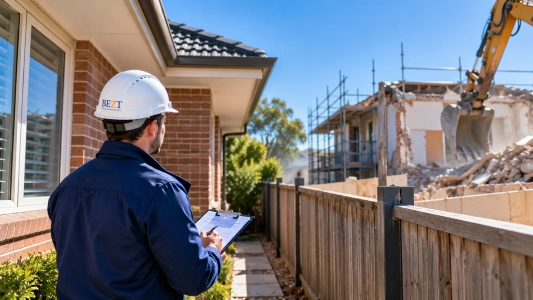

Construction starting next door can raise understandable questions about your own property. Demolition, excavation, changes to footings and other substantial building works may take place close to boundaries and existing structures.
That does not mean neighbouring construction will damage your property.
But before work begins, there can be real value in establishing a clear, documented record of your property’s existing condition.
A dilapidation report records observable cracks, defects, deterioration and other relevant conditions at a particular point in time. For property owners, a dilapidation report Melbourne inspection can provide an important pre-construction baseline that may later assist when comparing the property’s condition.
In Victoria, property-condition documentation can also have a formal role where the statutory protection-work process applies.
A dilapidation report is not about assuming damage will occur. It is about establishing what condition existed before relevant construction work began.
What is a dilapidation report?
A dilapidation report is a documented assessment of the observable condition of a property at the time of inspection.
Depending on the agreed scope and accessibility, it may record existing cracks, surface damage, deterioration and other visible conditions across relevant internal and external areas.
Written observations and photographs create a dated condition record that can be referred to if questions arise later.
This is why a dilapidation report Melbourne property owners arrange serves a very different purpose from a pre-purchase inspection. The focus is not on deciding whether to buy a property. It is on establishing its condition before nearby construction, demolition or other relevant works.
Why does the existing condition need to be documented?
Consider a crack that is noticed after construction has begun next door.
The presence of the crack alone does not establish when it developed or what caused it.
A pre-construction condition report can provide documented evidence of whether the same observable crack or defect was recorded before the work commenced. If a change is later identified, the earlier record provides a baseline against which the property’s condition can be compared.
This can be useful for adjoining property owners as well as those responsible for construction work.
The key distinction is important: the report records condition; it does not automatically establish causation or responsibility for later damage.
Is a dilapidation report legally required in Victoria?
Not for every construction project.
However, Victoria’s Building Act 1993 contains specific requirements where protection work is required for an adjoining property.
When a building permit application is made, the relevant building surveyor determines whether protection work is required. Where it is required, the building owner has obligations that include notifying the adjoining owner, arranging appropriate insurance and arranging a survey of the adjoining property before protection work commences.
That survey must record existing cracks and defects, and the record must be signed or otherwise acknowledged as an agreed record of the adjoining property’s condition before the protection work begins.
Where protection work is required, this is not simply an optional precaution. The Building Act process creates specific obligations for the building owner, including arranging the adjoining-property survey before protection work commences.
This statutory adjoining-property survey should not simply be treated as interchangeable with every commercially arranged dilapidation report. Whether the protection-work provisions apply depends on the particular building work and the relevant building surveyor’s determination.
If you receive a protection-work notice or are unsure about your rights or obligations, obtain appropriate professional or legal advice for your circumstances.
What condition should be recorded before construction begins?
The appropriate scope depends on the property, accessibility and the works being undertaken nearby.
Relevant observable conditions may include:
- existing cracking to accessible walls and surfaces
- damage or deterioration to finishes
- observable ceiling and floor conditions
- external wall conditions
- fences and boundary structures
- driveways, paving and paths
- other accessible areas relevant to the proposed works
Photographs can support the written observations by showing the condition of relevant areas on the inspection date.
The objective is to create a clear property condition record, not simply produce a long list of minor imperfections.
Timing matters: establish the baseline before work begins
A condition record becomes more useful when it clearly establishes the property’s condition before the relevant activity starts.
Ideally, a dilapidation inspection should therefore be completed before demolition, excavation, protection work or other relevant construction activity begins.
Once work is underway, an inspection can still document the condition visible on that date. What it cannot necessarily do is establish what was present before earlier construction activity occurred.
Where Victoria’s formal protection-work provisions apply, the adjoining-property survey must be arranged before the protection work commences.
For other situations, arranging condition documentation early can still provide a clearer pre-work reference point.
What if something changes during construction?
Suppose cracking appears to have increased, paving moves or another visible condition changes after nearby work begins.
An earlier report provides a point of comparison.
The pre-construction photographs and observations can be reviewed against the property’s later condition to determine what was previously documented and what appears different.
That comparison may be important, but it does not automatically explain why the change occurred.
Further assessment by an appropriately qualified professional may be required to investigate causation, significance or necessary remedial work.
A condition report establishes a baseline. Determining what caused a later change can require a separate assessment.
What if you’re the one planning the construction?
Condition reporting can also be relevant when you are carrying out the work.
If construction, demolition or excavation may affect adjoining property, understanding the existing condition of surrounding structures before work begins can provide a useful reference point for the project.
Where the relevant building surveyor determines that protection work is required in Victoria, the building owner has specific statutory responsibilities. These include the adjoining-property survey as well as protection-work notice and insurance requirements.
For projects outside that statutory process, builders, developers or property owners may still arrange condition documentation depending on the nature of the works and project requirements.
The important point is to establish the appropriate process before relevant work begins, rather than trying to reconstruct the original condition afterwards.
What a dilapidation report cannot establish?
A dilapidation report has an important purpose, but it also has limitations.
A visual inspection cannot document defects concealed behind finished walls, beneath inaccessible surfaces or within areas that cannot be safely accessed.
It cannot guarantee that construction will not cause damage.
And if a new defect or change is identified later, the report alone does not necessarily prove that neighbouring construction caused it.
Its strength is different: it provides a documented record of observable conditions within the inspection scope at a particular point in time.
Document the condition before the work begins
When construction or demolition is planned near your property, establishing the existing condition before work starts can provide a clearer reference point if concerns arise later.
BEZT Building & Pest Inspections provides dilapidation report Melbourne services that document observable property conditions across accessible areas within the agreed scope, supported by relevant observations and photographic records.
Whether you are an adjoining property owner or preparing for works near surrounding properties, having a structured pre-construction record can provide valuable evidence of the condition observed at the time of inspection.
Construction, demolition or excavation planned near your property? Get an instant quote from BEZT Building & Pest Inspections and arrange a dilapidation report before the relevant work begins.
Establish the condition before questions arise
The purpose of a dilapidation report is not to predict damage or assume that neighbouring construction will cause a problem.
Its value lies in establishing a documented record of observable conditions before relevant work begins.
A dilapidation report Melbourne property owners arrange at the appropriate stage can provide a clear pre-construction baseline and evidence of what was observed at that point in time.
That is considerably more useful than trying to establish the property’s original condition after work is already underway.
Frequently Asked Questions
Is a dilapidation report compulsory in Victoria?
Not for every construction project. However, where a relevant building surveyor determines that protection work is required under Victoria’s Building Act 1993, a survey of the adjoining property must be arranged before protection work begins. Other projects may use dilapidation reports for different contractual, project or risk-management purposes.
What is the difference between a dilapidation report and a protection-work survey?
A dilapidation report generally documents observable property condition for a defined purpose. A survey of adjoining property under Victoria’s protection-work provisions has a specific statutory role and requirements. The two should not automatically be treated as interchangeable.
Who is responsible for the adjoining-property survey when protection work applies?
Under the Victorian protection-work process, the owner carrying out the building work must arrange for the survey of the adjoining property with the adjoining owner before protection work begins.
What happens if construction has already started?
An inspection can still document conditions observable on the inspection date. However, without an appropriate earlier record, it may be more difficult to establish which conditions existed before work commenced.
Does a dilapidation report prove construction caused a crack?
No. It can establish whether a crack or other observable condition was recorded at the time of the earlier inspection. Determining what caused a later condition or change may require further professional assessment.
Can the property's condition be inspected again after construction?
A later inspection may be useful where comparison with the original condition record is required. Whether this is appropriate depends on the purpose of the original report, the work undertaken and any concerns identified afterwards.